Key takeaways
- Two verified gas-phase air purifiers built for VOCs and chemicals, compared by carbon media, room size and filtration stages.
Disclosure: As an Amazon Associate, we earn from qualifying purchases.
Our top pick: Austin Air HealthMate Plus. Runner-up: IQAir GC MultiGas XE.
Most air purifiers are built for particles. A HEPA filter is excellent at trapping dust, pollen and pet dander, but gases pass straight through it, and volatile organic compounds — the fumes given off by paint, new furniture, pressed-wood flooring, cleaning products, adhesives and renovation materials — are gases. A purifier that genuinely addresses chemicals needs a deep bed of activated carbon and, for the harder compounds such as formaldehyde, carbon or mineral media that has been chemically impregnated so it reacts with the gas instead of only adsorbing it. That requirement narrows the field sharply. The thin carbon pads fitted to most consumer purifiers hold too little media to matter for sustained chemical exposure, so this guide covers only the two models that could be verified against real Amazon US listings and that are built around heavy gas-phase filtration: a deep-bed carbon and zeolite machine from Austin Air, and a cartridge-based gas and odor unit from IQAir. Both are the same product type — room air purifiers designed for gases, odors and VOCs — and each is described only with the specifications recorded from its listing and manufacturer information.
It also helps to know where the load in a typical home actually comes from. Pressed-wood products — flat-pack furniture, laminate flooring, kitchen cabinets, plywood shelving — emit formaldehyde from their resins, most strongly when new and in warm rooms. Paints, varnishes and adhesives release a burst of solvents during a renovation that fades over weeks, while some materials keep emitting at a low level for far longer. Scented cleaning products, air fresheners and craft materials add their own mix. These are continuous, low-level sources inside closed rooms — exactly the pattern a deep carbon bed is designed to work against.
One caution before the picks themselves. No portable purifier removes the need for source control and ventilation. Sealing or removing the material that is emitting, and bringing in fresh air where that is possible, does more than any machine. What a heavy carbon purifier does is reduce the ongoing concentration of gases in a room where the source cannot be removed right away — a newly renovated bedroom, a workshop, a nail or craft space, or a home near traffic or industrial fumes. Read the two models below with that job in mind, and pay closest attention to the amount and type of gas-phase media each one carries, because that is what separates a chemical purifier from a dust purifier with a carbon sheet added.
Quick Picks
- Austin Air HealthMate Plus — Best for sustained chemical and VOC exposure: over 780 cubic inches of activated carbon, potassium-iodide-impregnated carbon and zeolite, plus a large true medical-grade HEPA stage, for rooms up to about 1,500 square feet per the manufacturer.
- IQAir GC MultiGas XE — Best for targeted gas and odor control with smart controls: granular activated carbon and impregnated alumina cartridges with a HyperHEPA particle stage, for rooms up to 1,125 square feet.
Austin Air HealthMate Plus

OUR TOP PICK
The HealthMate Plus is the model in this guide built most directly for chemicals. As recorded from the listing, its filtration runs in four stages, and the gas-phase stage is the headline: over 780 cubic inches of activated carbon, potassium-iodide-impregnated carbon and zeolite. That mixture matters. Plain activated carbon adsorbs a wide range of organic vapors, but formaldehyde and some other light compounds are poorly held by untreated carbon; potassium iodide impregnation gives the media a chemical reaction pathway for those gases, and zeolite adds adsorption capacity for a further range of compounds and odors. This is the combination to look for when the concern is renovation fumes, formaldehyde from pressed wood, or chemical sensitivity rather than ordinary household smells.
Behind the carbon stage sits 60 square feet of true medical-grade HEPA, as recorded from the listing, which handles the particle side of the air — dust, pollen and mold spores — so the machine is not a gas-only device. The manufacturer rates the unit for rooms up to about 1,500 square feet, which makes it the larger-room option of the two models here. The design is a floor-standing steel-bodied unit rather than a lightweight plastic tower, and that construction suits a machine intended to run continuously in one room for years rather than be carried from room to room.
In use, the HealthMate Plus is the pick for a room with a persistent chemical load: a bedroom furnished with new pressed-wood furniture, a home office after painting, or a living space where a household member reacts to fragrances and fumes. Its strength is the sheer mass of its gas-phase media. A deep carbon bed keeps working long after a thin pad has saturated, and saturation is the quiet failure mode of small purifiers — the fan still runs and the air still moves, but the gases pass through untreated. With over 780 cubic inches of media, this unit is built to delay that point far longer than pad-based machines.
Placement and running pattern suit that single-room role. The unit draws air in and returns it to the same space, so it belongs where the exposure and the people are — beside the bed in a renovated bedroom, or in the room where new furniture is off-gassing — with space around it for air to circulate. Because adsorption works on contact time and repeated passes, the effective way to run a machine like this is continuously at a moderate speed, rather than switching it on only when a smell becomes noticeable. By the time a chemical odor is obvious, the concentration has already built up; steady running keeps it from building in the first place.
The trade-offs are the ones expected from a heavy-media design. The unit is substantial and is best placed once, in the room where the exposure happens, rather than moved around the house. And because the carbon bed is the working part, its eventual replacement is the running cost that matters; buyers should plan around the filter’s service life rather than treating the purchase as the end of the expense.
Specs
– Model: HealthMate Plus (B450), Sandstone finish
– Filtration: 4-stage, as recorded from the listing
– Gas-phase media: over 780 cubic inches of activated carbon, potassium-iodide-impregnated carbon and zeolite
– Particle stage: 60 square feet of true medical-grade HEPA, as recorded from the listing
– Room coverage: up to about 1,500 square feet, per the manufacturer
Pros
– Deepest gas-phase media bed in this guide, aimed at VOCs and formaldehyde
– Impregnated carbon and zeolite, not plain carbon alone
– Large true medical-grade HEPA stage covers particles as well as gases
– Rated for rooms up to about 1,500 square feet per the manufacturer
Cons
– Large floor-standing unit, best placed in one room rather than moved about
– The carbon bed is a significant eventual replacement cost
IQAir GC MultiGas XE
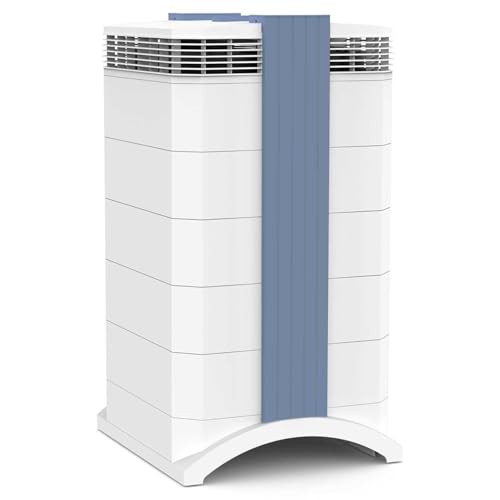
The GC MultiGas XE is IQAir’s gas and odor model, and it takes a different route to the same job. As recorded for this guide, it uses granular activated carbon and impregnated alumina in cartridge form for chemicals, odors and VOCs, paired with a HyperHEPA particle stage. The cartridge format is the distinguishing feature: the gas-phase media is held in replaceable cartridges, so when the media is spent, the cartridges are swapped rather than the whole filter assembly. Impregnated alumina, like the impregnated carbon in the Austin Air above, is there for the compounds that plain adsorption handles badly, which keeps this unit inside the chemical-purifier category rather than the general odor category.
The manufacturer rates the GC MultiGas XE for rooms up to 1,125 square feet, as recorded for this guide — a smaller ceiling than the HealthMate Plus, but still sized for a large bedroom, living room or open workspace. It also adds WiFi and smart controls, which the Austin Air does not: scheduling, remote adjustment and filter-life monitoring from a phone. For a machine that may need to run harder at some times than others — during and after painting, for example, or when outdoor fumes are worst — that control is a practical difference rather than a novelty.
The unit is Swiss made, as recorded for this guide, and is positioned as the more instrumented of the two models here: pick it when the exposure is intermittent or variable, when the room is within its coverage rating, and when monitoring filter life and adjusting the machine remotely will actually be used. Pick the Austin Air instead when the load is constant and the priority is the largest possible bed of impregnated media in a single cabinet.
The cartridge design also changes how the machine ages. In a combined filter assembly, the carbon and the particle media are replaced together whether or not both are spent; in a cartridge system, the gas cartridges and the particle stage follow their own schedules, so a household dealing mainly with gases is not discarding particle capacity it has not used. For buyers comparing long-term running costs between the two models in this guide, that difference in how the media is packaged is worth as much attention as the headline room ratings.
One verification note applies to this model. The single-unit listing details for the GC MultiGas XE were corroborated through an amazon.ca listing copy and mirror listings rather than a captured amazon.com copy, so confirm the exact configuration and cartridge set on the live Amazon US product page before buying. The specifications in this section are the manufacturer’s figures for the model as recorded during research.
Specs
– Model: GC MultiGas XE
– Gas-phase media: granular activated carbon and impregnated alumina cartridges, as recorded for this guide
– Particle stage: HyperHEPA filtration
– Room coverage: up to 1,125 square feet, as recorded for this guide
– Controls: WiFi and smart controls
– Origin: Swiss made
Pros
– Cartridge-based gas media, replaceable without changing the whole filter assembly
– Impregnated alumina covers compounds that plain carbon handles badly
– HyperHEPA particle stage alongside the gas filtration
– WiFi and smart controls for scheduling and filter-life monitoring
Cons
– Rated for smaller rooms than the HealthMate Plus, up to 1,125 square feet
– Single-unit listing details were corroborated indirectly, so the live product page should be checked before buying
How to Choose
Start with the media, not the fan. For VOCs and chemicals, the single most important specification is how much gas-phase media the machine carries and what kind it is. Deep beds of granular activated carbon — measured in pounds or, as with the HealthMate Plus, in hundreds of cubic inches — keep adsorbing for far longer than the thin carbon sheets in particle-first purifiers. When the concern includes formaldehyde, look for impregnation: potassium-iodide-treated carbon, impregnated alumina, or a carbon and zeolite blend. Untreated carbon is a poor match for formaldehyde, and a purifier that does not name its media treatment is usually a particle machine with a token carbon pad.
Next, match the room rating to the room, and be honest about which room matters. Chemical exposure is worst where a person spends the most hours, which is usually the bedroom. A purifier rated for about 1,500 square feet, like the HealthMate Plus, has headroom to run on a lower, quieter setting in a normal bedroom and still turn the air over; a unit rated at 1,125 square feet, like the GC MultiGas XE, suits bedrooms and living rooms within that figure. Ratings assume a closed room and standard ceiling height, and running any purifier with the door open to the rest of the house dilutes what it can achieve.
Then think about the source. A purifier treats the air in the room; it does not stop a new floor, cabinet or sofa from emitting. Where a source can be sealed with a low-emission coating, moved out, or aired outdoors before being brought in, do that first and let the purifier handle the remainder. Where the source is the building itself or comes from outside — traffic fumes, a nearby workshop, wildfire smoke drifting in — the purifier is the main line of defense, and media mass matters even more.
Consider the maintenance pattern next. Both models in this guide concentrate their cost in the gas-phase media: a combined filter assembly in the HealthMate Plus, replaceable cartridges in the GC MultiGas XE. Cartridges make the swap simpler and let the particle stage be serviced on its own schedule; a single large assembly means fewer parts to track. Either way, spent carbon cannot be washed or revived at home, and a saturated bed silently stops treating gases while the fan keeps running, so filter-life monitoring — built into the IQAir’s smart controls — has real value in this category.
Ignore particle clean-air delivery figures when comparing chemical purifiers. The headline air-flow numbers quoted for most purifiers describe particle removal, and a machine can post an impressive figure while carrying almost no carbon. For gases there is no equivalent single number, so the media specification — weight or volume of carbon, its type, and whether it is impregnated — is the comparison that counts. Two purifiers with similar airflow can differ tenfold in how much gas-phase media they carry, and it is the media, not the fan, that runs out first.
Noise deserves a thought as well, because a chemical purifier only works while it is running, and it needs to run in the room where people sleep or sit for long periods. A larger unit running slowly is generally easier to live with than a small unit running at full speed to achieve the same turnover, which favours a model whose room rating comfortably exceeds the actual room.
Placement is simpler than with particle purifiers but still matters. Put the machine in the room where the exposure is, with clearance around its intake and outlet, and run it continuously on a moderate setting rather than in short bursts on the highest one: gas adsorption is a contact process, and steady turnover at a sustainable noise level beats occasional blasts. Finally, keep expectations in proportion. A heavy carbon purifier lowers the concentration of VOCs in a room over time; it does not make a freshly painted room instantly safe to occupy, and ventilation with outdoor air, when outdoor air is clean, remains the fastest way to dilute indoor gases.
FAQs
Can a HEPA purifier remove VOCs and chemical fumes?
No. HEPA media traps particles, and gases such as formaldehyde, benzene and paint fumes pass through it. Removing VOCs requires gas-phase filtration — a substantial bed of activated carbon, ideally impregnated or blended with zeolite for the compounds plain carbon holds poorly. That is why both models in this guide are built around deep carbon media rather than around their particle stages, which are there to handle dust and pollen alongside the gases.
Which matters more for formaldehyde, carbon quantity or carbon type?
Both, but type is the threshold question. Formaldehyde is a small, light molecule that untreated activated carbon adsorbs weakly and releases easily, so a large bed of plain carbon can disappoint. Impregnated media — potassium-iodide-treated carbon as in the HealthMate Plus, or impregnated alumina as in the GC MultiGas XE — reacts chemically with formaldehyde and holds it far more reliably. Once the type is right, quantity decides how long the media lasts before saturation.
How do I know when the carbon media is spent?
Often by the return of the problem: odors and fumes that the machine had been suppressing begin to come through again, because saturated carbon stops adsorbing while the fan continues to run normally. There is no reliable home method for restoring spent carbon. The GC MultiGas XE’s smart controls track filter life, which helps; with any model, note the installation date of the media and treat a returning chemical smell as the signal to replace it rather than turning the fan speed up.
Conclusion
For sustained chemical and VOC exposure, the Austin Air HealthMate Plus is the top pick: over 780 cubic inches of activated carbon, potassium-iodide-impregnated carbon and zeolite, a 60-square-foot true medical-grade HEPA stage, and a manufacturer rating for rooms up to about 1,500 square feet. The IQAir GC MultiGas XE is the runner-up for rooms up to 1,125 square feet, with cartridge-based granular carbon and impregnated alumina, a HyperHEPA particle stage, and WiFi controls that make filter-life and scheduling easier to manage — with the caveat that its single-unit listing details should be confirmed on the live Amazon US page before buying. Whichever model fits the room, pair it with source control and ventilation: the purifier lowers what remains in the air, and that combination is what makes a chemically loaded room comfortable to live in.