Key takeaways
- Simple timer-based or gravity feeders. A gravity feeder has no scheduling, but it is cheap and has nothing to fail.
- A puzzle feeder or slow bowl. If the goal is slowing down a fast eater instead of scheduling, a slow-feed bowl may be enough.
- A higher tier with dual hoppers. PETKIT’s YumShare Dual-hopper 2 is listed at 5 L split into two hoppers, with a camera and pet recognition; it is likely above this cap, and PETKIT pages differ on its battery backup time (30 or 60 days), so check the manual. Two hoppers suit owners who want to feed two foods.
The best cat feeder under $150 depends on how many cats you feed and what they eat: the Petlibro Granary WiFi (5 L) suits one cat on dry food with app scheduling, the PETKIT Fresh Element Solo (3 L) suits a compact setup with a built-in desiccant box, the Petlibro Air (2 L) suits small spaces and battery use, and the Petlibro One RFID suits multi-cat homes where one cat needs its own food. Every model confirmed here is a dry-food dispenser, so wet food needs a different product type.
Our top picks



As an Amazon Associate we earn from qualifying purchases at no extra cost to you.
At a glance: stated specs
All figures come from the makers’ own product pages. Regional pages for the same model sometimes differ, and where that happens it is noted.
| Feeder | Capacity | Schedule and portions | Power and backup | Best for | Limits |
|---|---|---|---|---|---|
| Petlibro Granary WiFi (PLAF103) | 5 L | 1 to 10 meals per day, 1 to 50 portions per meal at 20 ml each | USB adapter plus battery backup; 2.4 GHz and 5 GHz WiFi | One or two cats on kibble, remote scheduling | Kibble only, 2 to 15 mm per the maker; one regional page lists 2 to 10 mm |
| Petlibro Granary Camera (PLAF203) | 5 L | App scheduling | DC 5V adapter, 3 D batteries as backup (not included) | Owners who want to see the cat eat | Camera adds cost; video storage via microSD up to 256 GB or a paid cloud option |
| Petlibro Basic WiFi (PLAF101) | 4 L | 1 to 10 meals per day, 1 to 12 portions at 12.5 ml | 2.4 GHz only | Simple scheduling on a tighter budget | Kibble 2 to 10 mm; no 5 GHz |
| Petlibro Air (PLAF008) | 2 L | 1 to 6 meals per day, 10.4 ml portions | The listing says battery life lasts up to 180 days | Small homes, travelers, simple timer use | Small hopper; only 6 meals per day |
| Petlibro One RFID (PLAF301) | 3 L | Opens for the paired collar tag | Corded; 3 D batteries as emergency backup (not included), with limited functions in battery mode | Multi-cat homes with a food-restricted cat | Reads only the dedicated collar tag, not microchips; syncs one tag |
| PETKIT Fresh Element Solo (P570) | 3 L (12 cups) | Up to 10 meals per day, 1 to 5 portions per meal, about 10 g each | 5V adapter (not included); 5 AAA batteries as backup (not included) | Compact single-cat feeding, app records | 2.4 GHz WiFi only; no camera; kibble over 12 mm should be avoided |
What an automatic cat feeder actually solves
A feeder helps with timing and portion control. It can hold a schedule while you are at work, run an early breakfast so a cat stops waking you at dawn, or dispense small measured meals for a cat on a plan from the vet. It does not replace daily checks. Cats can jam a dispenser, knock a feeder over or chew a cord, and power or WiFi can fail. For trips longer than a day or two, many owners still arrange a person to look in on the cat. If your cat has a medical condition, such as diabetes or kidney disease, ask your vet how meals should be timed and sized before setting a schedule.
Petlibro Granary WiFi: the all-rounder for dry food
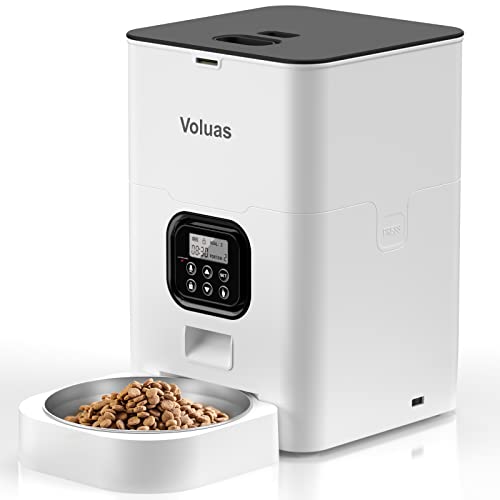
The Granary WiFi line is the one most buyers will be comparing first. The maker lists a 5 L hopper and a 34 by 19 by 19 cm body; weight is given as 2 kg on the product page and 1.66 kg in the manual. Petlibro describes it as suited to cats and small to medium dogs. It can schedule 1 to 10 meals per day with 1 to 50 portions per meal, each portion 20 ml. A USB adapter powers it and a battery backup keeps it feeding through an outage, and it works on both 2.4 GHz and 5 GHz WiFi, which avoids a common setup headache with router bands.
Kibble size is the detail worth checking. The maker’s main page lists 2 to 15 mm, while another listing gives 28 by 19 by 19 cm, 2 kg and a 2 to 10 mm kibble note. When listings differ, trust the box and manual that ship with the unit and check your cat’s food against the smaller figure if unsure. A 20 ml portion is also fairly large, so if you feed small precise meals to a small cat, a feeder with a smaller minimum portion may suit better.
Pick this if you have one or two cats on dry food, want remote control and prefer a larger hopper so refills are less frequent. Dry food stored for a long period can go stale, so many owners fill it only partially and clean the hopper regularly.
Petlibro Granary Camera: when you want to watch
The camera model lists a 1080p camera with a 145 degree wide-angle lens, a 5 L hopper, a 35.9 by 18.55 by 35 cm body and a net weight of 1.7 kg. It runs on a DC 5V adapter with 3 D batteries as backup. Video can be saved to a microSD card up to 256 GB or to cloud storage sold through the app. A dual-bowl version is also listed.
The extra feature suits owners who worry about whether the cat is eating or want to see feeding behavior. Appetite changes are worth noting, and if your cat stops eating for a day or more, call the vet; a camera can help show you what happened but it cannot diagnose anything. Because a camera adds to the price, this model is the one most likely to push a purchase toward or past the cap, depending on the bundle.
Petlibro Basic WiFi: simple and smaller
The Basic WiFi (PLAF101) has a 4 L tank and an LCD screen, measuring 19 by 19 by 30 cm and weighing 2.15 kg net. It allows 1 to 10 meals a day and 1 to 12 portions per meal at 12.5 ml each, which gives finer control than the 20 ml portion on the Granary. Kibble size is listed as 2 to 10 mm. It connects on 2.4 GHz only.
That 2.4 GHz limit matters in homes where the router combines bands in a way that confuses setup. Most routers still support 2.4 GHz, but it is worth knowing before you start. Pick this one if you want the smaller portion size and basic app control without extras.
Petlibro Air: for small spaces
The Air (PLAF008) holds 2 L, measures 31 by 26.5 by 18 cm and allows 1 to 6 meals a day with 10.4 ml portions. The listing says battery life can last up to 180 days. A related model, the Air Smart Feeder (PLAF108), has a rechargeable battery listed at up to 30 days, up to 10 meals a day and the same 2 L capacity.
A 2 L hopper empties fast with a large cat, so it fits small cats, kittens being fed set portions, or short absences. It is a reasonable pick for apartments where a bulky feeder looks out of place. If you cannot tell the Air and the Air Smart Feeder apart on a listing, read the model number first, because the battery life and meal count differ.
Petlibro One RFID: for homes with more than one cat
Multi-cat feeding is hard to automate. The One RFID (PLAF301) addresses it with an RFID reader that checks the cat’s collar tag before the lid unlocks. The maker lists a 3 L capacity, 442 by 196 by 320 mm dimensions, corded power with 3 D batteries as emergency backup, dual-band WiFi and kibble of 2 to 15 mm. The limits are plain: it reads only the dedicated collar tag, not microchips, and it syncs with just one tag.
That means it works best when one cat needs protected food, for example a cat on a prescription or weight-management diet while the others free-feed elsewhere. It does not manage several cats on separate schedules. Cats can wear collars safely when the collar is a breakaway type, so ask your vet or follow the collar maker’s guidance on fit and safety. Never leave a cat wearing a collar that cannot release if it is snagged.
PETKIT Fresh Element Solo: compact and sealed
PETKIT lists the Fresh Element Solo (P570) at 3 L or 12 cups, holding about 1.33 kg of food, which the maker says is roughly 15 days for an adult cat. It allows up to 10 meals a day with 1 to 5 portions per meal at about 10 g each; the maker notes the actual weight varies with kibble size and density. It measures about 167 by 296 by 316 mm and weighs about 1.32 kg. The maker warns against dry kibble over 12 mm and freeze-dried over 9 mm.
It uses a 5V adapter, which is not included. Backup comes from 5 AAA batteries, also not included; the backup duration depends on use, so check the manual. Connectivity is 2.4 GHz WiFi only. A sealed ring, built-in desiccant box and enclosed food outlet are meant to keep food fresh. There is no camera and no individual pet recognition. PETKIT lists it as suitable for cats and small-breed dogs over 3 months old; one retailer says small and medium dogs, so go by the maker. The manual and product page differ slightly on power ratings (6 V in the manual, 5 V on the page), so use the adapter specified in the manual.
Pick this for one cat, a small countertop footprint and a 10 g minimum portion. PETKIT also sells the YumShare Solo 2, a 3 L camera model with pet recognition, which is a step up in features and price tier.
Pick X if… decision table
| If you need | Pick | Reason |
|---|---|---|
| One cat, big hopper, 5 GHz WiFi | Petlibro Granary WiFi | 5 L, 20 ml portions, dual-band WiFi |
| Seeing the cat eat | Petlibro Granary Camera | 1080p camera, 145 degree lens |
| Small portions on a tight budget | Petlibro Basic WiFi | 12.5 ml portions, 4 L tank |
| Tiny space or battery use | Petlibro Air | 2 L, battery listed up to 180 days |
| One cat on a restricted diet in a shared home | Petlibro One RFID | Tag-based lid unlocks for one cat |
| Sealed food and 10 g portions | PETKIT Fresh Element Solo | Desiccant box, enclosed outlet |
Alternatives
- Simple timer-based or gravity feeders. A gravity feeder has no scheduling, but it is cheap and has nothing to fail.
- A puzzle feeder or slow bowl. If the goal is slowing down a fast eater instead of scheduling, a slow-feed bowl may be enough.
- A higher tier with dual hoppers. PETKIT’s YumShare Dual-hopper 2 is listed at 5 L split into two hoppers, with a camera and pet recognition; it is likely above this cap, and PETKIT pages differ on its battery backup time (30 or 60 days), so check the manual. Two hoppers suit owners who want to feed two foods.
Frequently Asked Questions
Can an automatic cat feeder handle wet food?
The dispensers covered here are dry-food only. Wet food spoils at room temperature, so wet-food feeders use chilled compartments or timed lids. Look specifically for a product made for wet food.
How many meals a day should I set?
That depends on the cat’s age, weight and health. Many adult cats do well with two or more small meals, but kittens, seniors and cats with medical needs differ. Ask your veterinarian for a target amount and schedule, then set the feeder to match.
What happens if the power or WiFi goes out?
Several models list a battery backup and will keep to the schedule they already hold, but the length of backup varies by model. Check the manual for how the feeder behaves offline, and do not rely on a single feeder for a long absence.
Will it work with multiple cats?
A standard feeder cannot tell cats apart, so any cat can reach the food. The Petlibro One RFID opens only for the cat wearing the paired collar tag, which helps when one cat needs controlled portions. It reads only the dedicated tag and syncs one tag.
What kibble size works?
The makers list limits, such as 2 to 15 mm on one Petlibro page, 2 to 10 mm on others, and a 12 mm upper limit for PETKIT. If your kibble is larger or irregular, choose accordingly or test a few meals first.
Do I still need to check on my cat?
Yes. A feeder can jam or run empty, and changes in eating are an important health signal. Check the hopper, the bowl and the cat daily, and see a vet if appetite drops.