Our Short List of 3

- Best for: Households with a standard weekday and weekend routine who want set-and-forget scheduling.
- White programmable thermostat, model RTH20B
- 5-2 day schedule
- Single-stage compatibility, 1 heat/1 cool
- Conventional system support stated in the listing

- Best for: Anyone who wants one set temperature with no programming, apps, or schedules to manage.
- Non-programmable thermostat for home use
- 1 heat/1 cool conventional single-stage systems
- Blue backlight display
- Suuwer brand listing

- Best for: Households that want app and voice control at the affordable end of the smart range.
- Smart thermostat with Wi-Fi, model ST55
- Alexa support stated in the listing
- Energy Star Certified
- DIY positioning stated in the listing
All 5 Picks at a Glance
| Product | Specs | Action |
|---|---|---|
| 1. Honeywell Home X2P Programmable Thermostat |
| Check price on Amazon |
| 2. Suuwer Non-Programmable Thermostat |
| Check price on Amazon |
| 3. Sensi Smart Thermostat ST55 |
| Check price on Amazon |
 4. Climapeak Non-Programmable Thermostat |
| Check price on Amazon |
 5. ecobee Smart Thermostat Essential |
| Check price on Amazon |
Key takeaways
- Compare five affordable thermostats, from a simple manual model to Wi-Fi smart picks, and match the schedule type and system support to your home.
An affordable thermostat sits at the modest end of its maker’s range: a simple control that holds the set temperature, without a large touchscreen, learning algorithm, or subscription. This guide uses “affordable” as budget framing only, stated openly — no listing here states a price, and no pick is claimed to cost less than any other. The five picks cover the three forms of the affordable class: programmable models with a weekly schedule, non-programmable models holding one set temperature, and entry-level smart models with Wi-Fi and voice control.
First, the thermostat must match the heating and cooling system already in the wall. Every pick is a low-voltage thermostat for conventional systems; none is built for line-voltage electric baseboard heating, which needs a thermostat labelled for that voltage. This guide gives no wiring or installation steps, and the listing wording alone never confirms fit for your system — check the model against your system type and staging, and ask a qualified installer where the listing calls for one.
Quick Picks
As an Amazon Associate we earn from qualifying purchases.
| Product | Best for | Key spec from title |
|---|---|---|
| Honeywell Home X2P Programmable Thermostat | Weekday and weekend schedules | 5-2 day schedule, single-stage |
| Suuwer Non-Programmable Thermostat | One set temperature, no programming | Non-programmable, 1 heat/1 cool |
| Sensi Smart Thermostat ST55 | Wi-Fi control with voice assistants | Wi-Fi, Alexa, Energy Star Certified |
| Climapeak Non-Programmable Thermostat | Battery-powered simplicity | Batteries included, blue backlight |
| ecobee Smart Thermostat Essential | Smart scheduling with voice platforms | Programmable Wi-Fi, Energy Star Certified |
How to Choose
Match the Schedule Type to Your Week
A programmable thermostat runs a schedule, changing the temperature at set times each day, while a non-programmable thermostat holds whatever temperature you choose until you change it. Common formats are 5-2 day, one program for weekdays and another for the weekend, and 7-day, a separate program for every day. A fixed working week suits a 5-2 day model, while shift work or irregular days call for 7-day programming. If nobody follows a pattern, a non-programmable model removes the schedule entirely. Smart models add app-based scheduling from a phone, provided the wiring supports it. Choose the schedule format first, because it shapes daily life with the thermostat more than any other feature.
Check System Type and Staging Before Anything Else
Thermostats are rated for particular system types, and a mismatch means a return, not a compromise. Most affordable models cover conventional single-stage systems, one stage of heating and one of cooling, and the listing should state that support plainly. Heat pumps, including systems with auxiliary or emergency heat, need a thermostat rated for heat pump operation, and multistage systems need multistage support — neither should be assumed from a general thermostat listing. Millivolt systems, found on some gas fireplaces and wall heaters, need their own thermostat type, and line-voltage baseboard systems need a line-voltage thermostat, a different product class entirely. Read the listing’s compatibility wording for your exact system, and confirm staging and heat pump support.
Decide How Much Smart Control You Want
Smart thermostats connect over Wi-Fi for phone or voice control, while other models are adjusted at the wall. The trade for Wi-Fi is power: a Wi-Fi radio needs a common wire, usually called a C wire, or an adapter, while simple battery-powered models sidestep the question entirely. Voice support varies, so check the listing for the exact platforms it names. App scheduling suits households that travel or keep irregular hours, but it adds setup steps and a wiring requirement that a basic model avoids. If the wall cable has no spare wire and no adapter is practical, stay with a battery-powered model and give up the app.
Weigh Power, Display, and Everyday Use
Everyday use comes down to power source, display, and how the temperature is changed. Battery-powered models run on replaceable batteries and keep working through a power cut, while C-wire models draw power from the system and never need a battery change. A backlit display matters in a dark hallway, and a large display helps where the thermostat sits across the room. Touchscreens guide setup with menus, while button models use plus and minus keys and a small screen. Filter-change and low-battery reminders appear on several affordable models and are worth having, since they prompt maintenance before comfort suffers. Pick the combination that fits the room, the lighting, and the people who will actually use it.
The 5 Best Options
1. Honeywell Home X2P Programmable Thermostat
- Best for: Households with a standard weekday and weekend routine who want set-and-forget scheduling.
- White programmable thermostat, model RTH20B
- 5-2 day schedule
- Single-stage compatibility, 1 heat/1 cool
- Conventional system support stated in the listing
Households with a standard weekday and weekend routine who want set-and-forget scheduling.
Heat pump and multistage support is not stated in the listing wording — confirm your system type before buying, and note that C-wire and Wi-Fi details are not stated either.
The Honeywell Home X2P is a white programmable thermostat built around a 5-2 day schedule, with separate weekday and weekend programs for households on a standard working week. Its listing states single-stage compatibility with one stage of heating and one stage of cooling, which covers the conventional forced-air systems found in most homes. Programming follows the familiar pattern of set times and temperatures, and the white finish suits a hallway or living room wall without drawing attention. The schedule-first design means the temperature changes on its own through the day, so the house is not heated or cooled out of habit while empty.
Watch out for: Heat pump and multistage support is not stated in the listing wording — confirm your system type before buying, and note that C-wire and Wi-Fi details are not stated either.
2. Suuwer Non-Programmable Thermostat
- Best for: Anyone who wants one set temperature with no programming, apps, or schedules to manage.
- Non-programmable thermostat for home use
- 1 heat/1 cool conventional single-stage systems
- Blue backlight display
- Suuwer brand listing
Anyone who wants one set temperature with no programming, apps, or schedules to manage.
Battery and C-wire details are not stated in the listing wording, and heat pump support is not stated either — confirm power and system fit before buying.
The Suuwer non-programmable thermostat strips the job back to its essentials: set a temperature, and the thermostat holds it until someone changes it. Its listing states conventional single-stage support with one stage of heating and one stage of cooling, and a blue backlight keeps the display readable in a dim hallway. With no schedule to program and no app to configure, there is nothing to set up beyond the temperature itself, which suits landlords, second homes, and anyone replacing a failed thermostat in a hurry. The simple design also means fewer settings to get wrong, and the temperature stays exactly where it was left.
Watch out for: Battery and C-wire details are not stated in the listing wording, and heat pump support is not stated either — confirm power and system fit before buying.
3. Sensi Smart Thermostat ST55
- Best for: Households that want app and voice control at the affordable end of the smart range.
- Smart thermostat with Wi-Fi, model ST55
- Alexa support stated in the listing
- Energy Star Certified
- DIY positioning stated in the listing
Households that want app and voice control at the affordable end of the smart range.
C-wire requirements, schedule format, and staging support are not stated in the listing wording — confirm wiring and system compatibility before buying.
The Sensi Smart Thermostat, model ST55, is the entry-level smart pick in this guide, adding Wi-Fi control and Alexa support to a thermostat at the affordable end of the smart range. Its listing states Energy Star certification and a do-it-yourself positioning, so setup is presented as a homeowner job rather than a specialist visit. App control means the temperature, holds, and alerts live on a phone, and voice control through Alexa covers quick changes without touching the wall unit. The smart features suit households that travel or keep changing hours, provided the wiring supports a Wi-Fi model.
Watch out for: C-wire requirements, schedule format, and staging support are not stated in the listing wording — confirm wiring and system compatibility before buying.
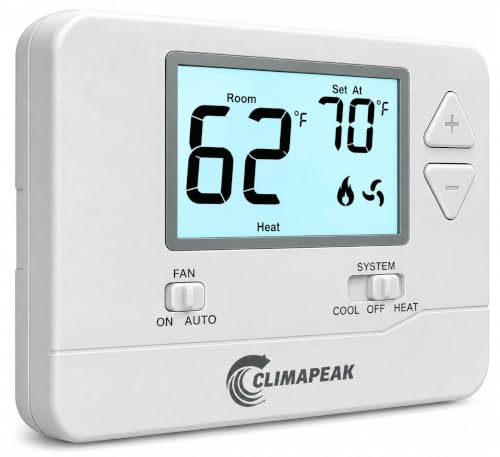
4. Climapeak Non-Programmable Thermostat
- Best for: Older homes without a C wire, and anyone who wants a battery-powered thermostat with no programming.
- Non-programmable thermostat, batteries included
- 1 heat/1 cool conventional single-stage systems
- Blue backlight display
- DIY friendly design stated in the listing
Older homes without a C wire, and anyone who wants a battery-powered thermostat with no programming.
Battery type and count, and heat pump support, are not stated in the listing wording — confirm both before buying, and note the single-stage limit.
The Climapeak non-programmable thermostat is a battery-powered model that ships with batteries included, so it sidesteps the common-wire question entirely and keeps working through a power cut. Its listing states conventional single-stage support with one stage of heating and one stage of cooling, plus a blue backlight and a do-it-yourself friendly design. There is no schedule to program and no app to set up, which makes it a straightforward replacement for a dead thermostat or a first thermostat in a simple system. The battery-powered design suits older homes whose thermostat cable has no spare wire for a C wire.
Watch out for: Battery type and count, and heat pump support, are not stated in the listing wording — confirm both before buying, and note the single-stage limit.
5. ecobee Smart Thermostat Essential
- Best for: Mixed-device households that want app scheduling plus a choice of voice assistants.
- Smart thermostat Essential, WiFi model
- Programmable Wi-Fi thermostat
- Energy Star Certified
- Works with Siri, Alexa, and Google Assistant
Mixed-device households that want app scheduling plus a choice of voice assistants.
C-wire requirements, sensor inclusion, and staging support are not stated in the listing wording — confirm wiring and system fit, and ask a qualified installer if the wiring is unclear.
The ecobee Smart Thermostat Essential is a programmable Wi-Fi thermostat that works with Siri, Alexa, and Google Assistant, covering all three major voice platforms in a single listing. Its listing states Energy Star certification and energy-saving wording, positioning it as the efficiency-minded smart pick at the affordable end of the range. Scheduling lives in the app, so programs can be adjusted from a phone, while voice control handles quick changes at home. The broad voice support suits households with mixed devices, where different family members use different assistants.
Watch out for: C-wire requirements, sensor inclusion, and staging support are not stated in the listing wording — confirm wiring and system fit, and ask a qualified installer if the wiring is unclear.
Which One Fits Your Situation
A Fixed Weekday Routine That Rarely Changes
A household on a standard working week, out at the same times each weekday, gets the most from a 5-2 day programmable model. Set both programs once, and the temperature follows the routine without further thought. The Honeywell X2P fits here, with its separate weekday and weekend programs and single-stage coverage for conventional systems. Keep it simple — wake, away, home, and sleep — and the thermostat stops conditioning an empty house.
An Irregular Schedule With Shifts and Changing Days
Shift workers and households where no two days look alike need 7-day programming or app-based scheduling changed on the move. A 5-2 day model will fight an irregular week, since its weekday program assumes five identical days. Look for flexible or 7-day scheduling in the listing, or a smart model with app control, and confirm staging support for multistage or heat pump systems. Pick the schedule that bends to the calendar, not the other way round.
An Older Home With No Spare Thermostat Wire
Older thermostat cable often has no C wire, and adding one can mean new cable or an adapter kit. Battery-powered models avoid the problem, running on replaceable batteries and keeping settings through a power cut. The Climapeak fits here, with batteries included and nothing to program, and the Suuwer suits the same wiring where a backlit display is wanted. Confirm a conventional single-stage system, since battery power does not change compatibility.
A First Smart Thermostat on a Modest Budget
A first smart thermostat should add Wi-Fi and voice control without a premium tier or complex install. The Sensi ST55 and ecobee Essential sit at the affordable end of the smart range, with Energy Star certification in their listings. Choose the Sensi where Alexa rules, and the ecobee where the household mixes Siri, Alexa, and Google Assistant. Before buying either, confirm the wall cable supports Wi-Fi, since both need power the listing wording does not fully describe.
Common Mistakes
- Buying a thermostat without checking system type, staging, and heat pump support in the listing wording.
- Assuming a Wi-Fi model works without a C wire, when the listing does not state the power requirement.
- Choosing a line-voltage thermostat for baseboard heating, or a low-voltage thermostat for a line-voltage system.
- Picking a 5-2 day schedule for an irregular week, then fighting the program every day.
- Treating “affordable” as a price promise instead of budget framing, and comparing picks on cost the listings never state.
Frequently Asked Questions
What does “affordable” mean in this guide?
“Affordable” is budget framing only, stated openly. It means each pick sits at the modest end of its maker’s range, with simple controls and no subscription or premium tier. No listing here states a price, and no pick is claimed to cost less than any other. Judge each model on its schedule type, system support, and stated features, and check the live listing for the current figure before buying.
Do I need a C wire for these thermostats?
It depends on the model. Battery-powered models need no C wire, which suits older homes whose cable has no spare wire. Wi-Fi models need continuous power, so they usually require a C wire or adapter kit — check the listing for the exact requirement. If the wall cable has no spare wire and no adapter is practical, stay with a battery-powered model.
Should I choose a programmable or non-programmable thermostat?
Choose programmable if the household follows a repeating weekly pattern, since a schedule changes the temperature on its own and stops conditioning an empty house. Choose non-programmable if nobody follows a pattern, or the household prefers direct control with nothing to program. A 5-2 day schedule suits a standard working week, while irregular weeks need 7-day or app-based scheduling instead.
Will an affordable thermostat work with a heat pump?
Only if the listing states heat pump support. Many affordable models cover conventional single-stage systems only, and heat pumps, especially with auxiliary or emergency heat, need a thermostat rated for that operation. Multistage systems need multistage support too. Read the listing’s compatibility wording for your exact system type and staging, and ask a qualified installer where the wording is unclear.