Our Short List of 3
- Best for: range shooters who want to hear commands and conversation.
- Electronic ear protection for shooting with 4X sound amplification
- NRR 23dB noise reduction rating
- Gun range hearing protection muffs, also framed for hunting
- Green colour

- Best for: buyers who want simple passive protection with nothing to charge.
- Brand and line: 3M PELTOR X5A
- Form: over-the-head earmuffs
- Type: passive hearing protection with no electronics stated

- Best for: shooters who want stronger amplification for quiet sounds.
- Electronic ear protection for shooting with 5X sound amplification
- Active ear protection for gun range use
- NRR 23dB hearing protection for shooters
- Noise reduction headphones framed for hunting
All 4 Picks at a Glance
| Product | Specs | Action |
|---|---|---|
| PROHEAR Electronic Ear Protection for Shooting |
| Check price on Amazon |
| 3M PELTOR X5A Over-the-Head Earmuffs |
| Check price on Amazon |
| Floriogra Electronic Ear Protection for Shooting |
| Check price on Amazon |
 Walker’s Razor Slim Electronic Muff, Carbon, One Size |
| Check price on Amazon |
Key takeaways
- Compare five protective ear muffs for shooting and range use, from electronic models with sound amplification to passive over-head designs and pick by fit.
The right protective ear muffs come down to how much noise you face and whether you need to hear anything while you wear them. Shooters need to hear range commands and conversation between shots, while workshop users need steady protection against saws, routers, and other loud tools. Electronic models amplify quiet sounds and cut off at loud peaks, while passive models block noise constantly with no batteries or switches to manage. Fit matters as much as the rating, because a muff that slips or pinches will spend more time around your neck than over your ears.
This guide covers five protective ear muffs chosen from product names and specifications on Amazon pages, spanning electronic amplification models and passive over-head designs. It is written for range shooters who need to hear commands, for hunters who need to hear their surroundings, for workshop users running loud power tools, and for first-time buyers who want a simple passive pair that works every time without charging or settings.
Quick Picks
As an Amazon Associate we earn from qualifying purchases.
| Product | Best for | Key spec from title |
|---|---|---|
| PROHEAR Electronic Ear Protection | Range shooting with amplification | 4X sound amplification, NRR 23dB |
| 3M PELTOR X5A Over-the-Head Earmuffs | Simple passive protection | Over-the-head earmuffs |
| Floriogra Electronic Ear Protection | Active protection for shooters | 5X sound amplification, NRR 23dB |
| Howard Leight Leightning L3 Earmuffs | Everyday workshop use | Leightning L3 earmuffs |
| Walker’s Razor Slim Electronic Muff | Slim electronic fit | Razor Slim electronic muff, one size |
How to Choose
Match the muff to the noise
Start with the loudest task the muffs will face, not the quietest one. Shooting and power tools produce short, sharp peaks that demand strong blocking, while mowing and shop cleanup produce steadier noise that a mid-range muff handles well. Electronic models react to peaks while letting quieter sounds through, which suits ranges where hearing commands matters. Passive models block everything at a constant level, which suits solo workshop sessions where conversation is not needed. Check the stated noise reduction rating on the listing and compare it across models in the same form, because a slim electronic muff and a bulky passive muff can carry very different ratings.
Decide between electronic and passive
Electronic muffs use microphones and speakers to amplify quiet sounds and suppress loud ones, so you can talk and hear range commands without removing them. They need batteries or charging, and they add weight, controls, and a higher chance of something failing at the wrong moment. Passive muffs have no electronics at all, so they work every time you put them on and need nothing but a wipe-down afterward. Choose electronic when hearing your surroundings is part of the job, and choose passive when simplicity and steady blocking matter more. Hunters and range officers usually gain the most from electronic models, while workshop users often prefer passive pairs.
Get the fit right before you buy
A muff only protects when its cushions seal fully around each ear, so headband shape, cup size, and cushion softness matter as much as any rating. Over-the-head bands suit most users, while slimmer cups fit better under hats, hoods, and shooting glasses without breaking the seal. One-size models rely on an adjustable band, so check that the listing states the adjustment range or size rather than assuming it fits every head. If you wear glasses, look for slim cups and soft cushions, because thick frames can lift the cushion edge and open a gap. A comfortable muff gets worn; an uncomfortable one gets left behind.
Check build, use, and upkeep
Look at what the listing states about the headband, cushions, and folding or storage, because these decide how the muffs survive daily use. Folding cups pack smaller in a range bag or toolbox, while fixed cups tend to feel sturdier over time. Replaceable cushions extend the life of a good pair, while sealed designs mean replacing the whole muff when the cushions wear out. Electronic models add battery type and control placement to check, including whether the volume control is easy to reach with gloves on. Keep the cushions clean and dry, store the muffs away from heat, and replace them when the seal weakens or the band loses tension.
The 5 Best Options
PROHEAR Electronic Ear Protection for Shooting
- Best for: range shooters who want to hear commands and conversation.
- Electronic ear protection for shooting with 4X sound amplification
- NRR 23dB noise reduction rating
- Gun range hearing protection muffs, also framed for hunting
- Green colour
range shooters who want to hear commands and conversation.
electronic models need power and care; the stated rating is moderate rather than maximum.
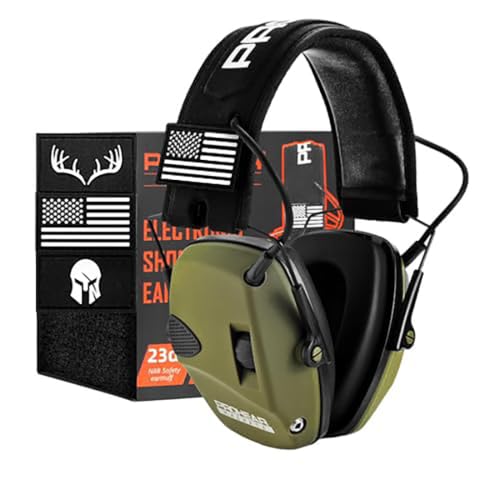
The PROHEAR electronic muffs suit shooters who want amplification for conversation and range commands alongside stated noise reduction for gunfire. The listing states 4X sound amplification with an NRR of 23dB, so quiet sounds come through louder while loud peaks are held back. The green muffs are framed for gun range use and hunting, which matches buyers who split time between the range and the field. Electronic controls add a step that passive muffs skip, and the stated rating sits below heavier passive models, so buyers facing the loudest indoor ranges should weigh that trade before choosing.
3M PELTOR X5A Over-the-Head Earmuffs
- Best for: buyers who want simple passive protection with nothing to charge.
- Brand and line: 3M PELTOR X5A
- Form: over-the-head earmuffs
- Type: passive hearing protection with no electronics stated
buyers who want simple passive protection with nothing to charge.
the listing title states no noise reduction rating, so confirm the rating before buying.
The 3M PELTOR X5A is a passive over-the-head earmuff for buyers who want protection with no batteries, switches, or settings to manage. The listing names the PELTOR X5A line in an over-the-head form, which places it among 3M’s passive earmuff designs for workshop and industrial use. Passive construction means the muffs work the same way every time they go on, with nothing to charge and nothing to switch on. The listing title states no noise reduction rating, so buyers should confirm the rating on the product page before relying on this pair for the loudest tasks.
Floriogra Electronic Ear Protection for Shooting
- Best for: shooters who want stronger amplification for quiet sounds.
- Electronic ear protection for shooting with 5X sound amplification
- Active ear protection for gun range use
- NRR 23dB hearing protection for shooters
- Noise reduction headphones framed for hunting
shooters who want stronger amplification for quiet sounds.
electronic models need power; the stated rating is moderate rather than maximum.
The Floriogra electronic muffs suit shooters who want stronger amplification than the PROHEAR pair, with the same stated NRR of 23dB. The listing states 5X sound amplification with active ear protection for gun range use, framed for shooters and hunting. That combination fits range sessions where hearing quiet speech matters as much as blocking peaks. Like other electronic models, these need power and add controls that passive muffs avoid, so buyers who want the simplest possible pair should look at the passive options here instead. The stated rating is moderate, so very loud indoor ranges may call for a higher-rated muff.
Howard Leight Leightning L3 Earmuffs
The Howard Leight Leightning L3 is a passive earmuff for workshop users and shooters who want a straightforward pair from a long-running hearing protection line. The listing names the Leightning L3 line in earmuff form, which places it among Howard Leight’s passive designs for steady noise. Passive construction keeps use simple, with no batteries to replace and no controls to learn, and the muffs are ready the moment they are put on. The listing title states no noise reduction rating and no headband style, so buyers should confirm both the rating and the fit details on the product page before choosing this pair for heavy work.
Specs
- Brand and line: Howard Leight Leightning L3
- Form: earmuffs
- Type: passive hearing protection with no electronics stated
Best for: everyday workshop use where simple steady protection is enough.
Watch out for: the listing title states no noise reduction rating, so confirm the rating before buying.
ASIN: ⚠ B0007X9QKK
Walker’s Razor Slim Electronic Muff, Carbon, One Size
- Best for: shooters who want a slim electronic muff that fits with glasses.
- Razor Slim electronic muff
- Hearing protection in earmuff form
- Colour: carbon
- Size: one size
shooters who want a slim electronic muff that fits with glasses.
one-size fit relies on adjustment, so confirm the fit range before buying.
The Walker’s Razor Slim electronic muff suits buyers who want a slim cup that fits easily under hats and alongside shooting glasses. The listing states a Razor Slim electronic muff in carbon with one size, framed as hearing protection in earmuff form. Slim cups reduce bulk and interference with glasses frames, which helps the cushion seal stay closed during long sessions. The one-size listing relies on adjustment rather than sized shells, so buyers with very large or small heads should confirm the fit range on the product page. As an electronic model, it needs power and adds controls that passive muffs skip.
Which One Fits Your Situation
You shoot at a range and need to hear commands
Pick an electronic model with stated amplification, because hearing range commands and conversation is part of safe range use. The PROHEAR and Floriogra pairs both state amplification with an NRR of 23dB, so the choice comes down to how much amplification you want and which colour and styling you prefer. Keep a passive pair in the bag as a backup, because electronic muffs are no use with dead batteries.
You work alone in a workshop
Pick a passive pair and skip the electronics entirely, because steady blocking with nothing to charge suits solo sessions with saws and routers. The 3M PELTOR X5A and Howard Leight Leightning L3 both offer passive construction with no settings to manage. Confirm the stated rating on the product page first, since neither listing title states one, and replace the pair when the cushions or band wear out.
You hunt and need to hear your surroundings
Pick an electronic model so quiet sounds reach you while loud shots are held back, and favour slim cups that sit well under a hat or hood. The Walker’s Razor Slim carbon muff fits this brief with its slim cup and one-size adjustable fit, while the PROHEAR and Floriogra pairs add stronger stated amplification. Test the fit with the hat and glasses you actually hunt in, because a broken seal wastes the rating.
You want the simplest pair that always works
Pick a passive over-the-head muff with no electronics, no batteries, and nothing to switch on, and keep it where you work or shoot so it is always within reach. The 3M PELTOR X5A over-the-head form is the most direct choice here, with the Howard Leight Leightning L3 as the alternate. Check the rating on the product page, confirm the fit, and store the muffs clean and dry between uses.
Common Mistakes
- Choosing by looks or colour instead of the stated noise reduction rating and the fit of the seal.
- Wearing muffs over thick glasses frames without checking that the cushions still seal fully around each ear.
- Buying electronic muffs and forgetting that dead batteries leave you with no amplification at the range.
- Assuming one size fits every head without confirming the adjustment range on the product page.
- Keeping worn-out cushions and loose headbands in use after the seal has weakened.
Frequently Asked Questions
Are electronic ear muffs better than passive ear muffs?
Electronic muffs are better when hearing quiet sounds matters, because they amplify speech and range commands while suppressing loud peaks. Passive muffs are better when simplicity matters, because they need no power and block noise at a constant level every time. Neither type is better in every case, so match the choice to the task: electronic for ranges and hunting, passive for solo workshop work and backup use.
What noise reduction rating do I need for shooting?
The rating you need depends on the firearm, the setting, and whether you shoot indoors or outdoors, so check the rating and compare models in the same form. Indoor ranges are louder than outdoor ones because sound reflects off walls, so they call for stronger protection. Some shooters double up with earplugs under muffs for the loudest settings, but the combined protection is less than the two ratings combined.
Can I wear ear muffs with shooting glasses?
Yes, but the glasses frames can lift the cushion edge and open a gap that lets noise through, so slim cups and soft cushions help. Try the exact glasses and muffs together before a long session, and adjust the headband so the cushions sit evenly around each ear. If the seal still gaps, try thinner frames or a different cup shape, because a broken seal wastes even a high rating.
How do I know when to replace ear muffs?
Replace ear muffs when the cushions harden, crack, or no longer seal evenly, or when the headband loses tension and the cups slip. Clean the cushions after use, keep the muffs dry and away from heat, and check the seal each time. Electronic models also need fresh batteries or charging on schedule, and any muff with damaged cups or a broken band should be replaced rather than repaired.