Key takeaways
- Looking for the best Android cell phone chargers? Compare USB-C PD and PPS fast chargers by wattage, ports, cable, and safety for Samsung, Pixel, and more.
Finding the best Android cell phone chargers is less about chasing the biggest wattage number on the box and more about matching a charger to the phone in your hand. Android phones from Samsung, Google Pixel, OnePlus, Motorola, and other makers all charge over USB-C, but they do not all use the same fast-charging language. Some rely on USB Power Delivery, known as USB-PD, while Samsung phones in particular get their fastest speeds from Programmable Power Supply, known as PPS. A charger that is perfect for one phone can be merely adequate for another, and the cable in the box matters just as much as the brick itself.

The quick answer is straightforward. For most Android owners, a compact 25W or 30W USB-C charger with USB-PD and PPS support is the right starting point. Samsung Galaxy owners who want the fastest supported speeds should look at a 45W PPS charger, while anyone who charges a phone and a tablet or laptop from one outlet should consider a 65W multi-device charger.
Quick Picks
| Charger | Best For | Output | Ports | Cable Included |
|---|---|---|---|---|
| Samsung 25W Travel Adapter | Samsung phones at 25W | 25W | 1 USB-C | No |
| Anker Nano 30W | Everyday carry and travel | 30W | 1 USB-C | No |
| Anker 313 Ace 2 45W | Samsung Super Fast Charging 2.0 | 45W | 1 USB-C | Varies by listing |
| Anker Nano II 65W | Phone plus tablet or laptop | 65W | 1 USB-C | No |
How to Choose
Match the Wattage to Your Phone
Start with the maximum charging speed your phone actually supports, not the maximum speed a charger can deliver. Many Samsung Galaxy phones support 25W charging, while Galaxy S Ultra models and some other flagships support 45W. Most Google Pixel phones charge at 30W or below, and many mid-range Android phones top out at 18W or 25W. A 65W charger will not force a 25W phone to charge at 65W. The phone and the charger negotiate a safe level, and the phone sets the ceiling.
Understand USB-PD and PPS
USB Power Delivery is the open standard that lets a USB-C charger and a phone agree on voltage and current. It covers the common fixed steps such as 5V, 9V, 15V, and 20V. PPS, or Programmable Power Supply, is an extension of USB-PD that allows the charger to adjust voltage in small steps. That fine adjustment is what Samsung uses for Super Fast Charging and Super Fast Charging 2.0, and it is also used by some Pixel and OnePlus fast-charging modes. If you own a Samsung Galaxy phone, a charger that lists PPS support is worth seeking out, because a plain USB-PD charger without PPS may charge the same phone at a lower speed even when its wattage looks high enough on paper.
Check the Cable Situation
Many modern Android chargers are sold as the wall adapter only, with no cable in the box. That is true of several picks in this guide, and it catches buyers out. A USB-C to USB-C cable is required for USB-PD and PPS fast charging, and not every cable is equal. For 25W and 30W charging, a standard USB-C cable rated for the job is usually enough. For 45W charging, Samsung recommends a 5A USB-C to USB-C cable, because a lower-rated cable can limit the charger to a slower speed. Before you buy, check whether a cable is included, and if one is not, make sure you already own a suitable USB-C cable or add one to your order.
Count the Ports You Really Need
A single-port charger is smaller, lighter, and simpler, and it gives its full output to one device. That is ideal for a bedside table or a travel bag where you charge one phone at a time. A multi-port charger is better for a desk or a shared outlet, where a phone, earbuds, and a tablet may all need power at once. Remember that the headline wattage on a multi-port charger is the total across all ports, not the wattage each port gets at the same time. When several devices are plugged in, the power is shared, so a phone may charge more slowly than it would on a single-port charger of the same total wattage.
Look at Size, GaN, and Folding Prongs
Gallium nitride, usually shortened to GaN, is the semiconductor material used in most modern compact chargers. GaN chargers run cooler and pack more power into a smaller body than older silicon chargers of the same wattage. That is why a 30W or 65W charger today can be barely larger than the small 5W brick that used to come in phone boxes. For travel, folding prongs are a real advantage, since they stop the charger snagging on other items in a bag. For a charger that will live permanently behind a bed or desk, size matters less, and a slightly larger brick with more ports may be the better choice.
Safety Features and Certification
A charger connects directly to mains power, so safety is not a detail to skip. Look for chargers from established brands with over-current, over-voltage, short-circuit, and temperature protection built in. Certifications from recognised testing bodies, and a charger sold by the brand itself or an authorised seller, are good signs. Avoid unbranded chargers with no clear manufacturer, no model number, and no safety markings, however low the wattage claim on the listing may look.
Think About What Else You Charge
The best charger for your phone may also be the charger for your earbuds, your smartwatch, your tablet, and even a lightweight laptop. If you travel with several USB-C devices, a 65W charger can replace two or three smaller bricks and free up outlet space. If you only ever charge one phone, a 25W or 30W single-port charger is lighter, simpler, and easier to carry. Also consider where the charger will live. A compact charger with folding prongs suits a pocket or a carry-on bag, while a charger with a longer cable suits a bedside table where the outlet sits far from the pillow.
The Best Best Android Cell Phone Chargers Reviewed
Samsung 25W Travel Adapter
The Samsung 25W Travel Adapter is the most direct choice for Samsung Galaxy owners whose phones support 25W charging. It is Samsung’s own adapter, model EP-T2510, with a single USB-C port and support for USB Power Delivery 3.0 with PPS, which is the combination Samsung phones use for Super Fast Charging. It is small, light, and easy to slip into a bag, and its compact design makes it a natural fit for travel and for a bedside table where outlet space is tight.
In use, this adapter suits Galaxy S, Galaxy A, Galaxy Z, and Galaxy Note owners whose phones top out at 25W, as well as Pixel and other Android phones that charge happily over USB-PD. It also works with tablets and accessories that charge over USB-C, although its 25W ceiling means a large tablet will charge more slowly than it would on a higher-wattage brick. The single port keeps things simple: one device, full attention, no power sharing to think about.
Partial-fit flag: this adapter is sold without a cable in the box, so you will need your own USB-C to USB-C cable to use it. That is worth knowing before you buy, especially if your phone came without a cable either. Also note that this is a 25W charger, so Galaxy Ultra owners who want the fastest supported speeds should look at the 45W pick below instead.
Anker Nano 30W
The Anker Nano 30W, also sold as the Anker 511 Charger (Nano 3), model A2147, is a tiny GaN charger with a single USB-C port and folding prongs. It supports USB Power Delivery and PPS fast charging, which makes it a strong match for Pixel phones and Samsung phones that charge at 30W or below. Its size is the main attraction: it is barely larger than a sugar cube, yet it delivers enough power for a phone, earbuds, a smartwatch, or a small tablet.
This is the charger to pick when portability matters most. It fits in a jacket pocket, a small bag, or a crowded power strip without blocking the neighbouring outlet. The folding prongs protect the plug in transit and keep the charger tidy when it is not in use. It is also a sensible everyday charger for a desk or a kitchen counter, where one phone charges at a time and a large brick would be overkill.
Partial-fit flag: the standard single-pack version of this charger is sold without a cable, so check the listing carefully and add a USB-C cable if you need one. Some bundled versions include a cable, which is why the cable column in the Quick Picks table says no for the standard pack. It also has only one port, so it cannot charge two devices at once.
Anker 313 Ace 2 45W
The Anker 313 Ace 2 45W, model A2653, is built for Samsung owners who want Super Fast Charging 2.0. It is a single-port USB-C charger with PPS support, designed to deliver up to 45W to compatible Galaxy phones such as the Galaxy S24 Ultra, Galaxy S23 Ultra, and Galaxy S22 Ultra. That makes it the fastest phone charger in this guide for Samsung flagships, and it also charges Pixel phones, tablets, and other USB-C devices at their own supported speeds.
What sets this charger apart is its focus. Where general-purpose chargers list broad compatibility, this one is tuned for the PPS profiles Samsung phones use at 45W, so Galaxy owners are more likely to see the fastest charging their phone supports. It is still a compact GaN charger, so it travels well, and its single USB-C port means the full 45W is available to the one device plugged in.
Partial-fit flag: cable inclusion varies by listing. Some listings for this charger are sold as a two-pack with USB-C cables included, while the single charger version is sold without a cable. Check the exact listing, including the number of chargers and cables, before you buy, so you receive the version you expect. As with every charger here, a suitable 5A USB-C cable is needed for full 45W Samsung charging.
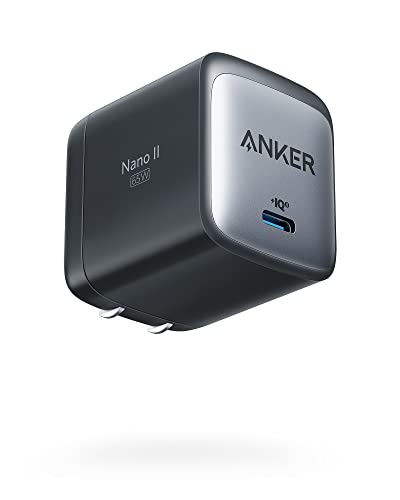
Anker Nano II 65W
The Anker Nano II 65W, model A2663, is the most powerful charger in this guide, and the best choice when one charger needs to cover a phone and something larger. It has a single USB-C port, GaN II technology, and folding prongs, and it delivers up to 65W over USB Power Delivery. That is enough for a phone, a tablet, and many thin and light laptops, which makes it a useful one-brick solution for a work bag or a desk.
For Android phones, the extra headroom is about flexibility rather than speed. A phone that supports 25W or 30W charging will only draw what it needs, so the 65W rating does not make the phone charge faster than it would on a matching 25W or 30W charger. Where the 65W rating earns its place is when the same charger also tops up a tablet or a laptop, or when you want one charger that will still be useful if your next phone or tablet supports faster charging.
Partial-fit flag: this charger is sold without a cable, and it has only one USB-C port, so it charges one device at a time despite its high total output. Samsung owners should also note that this is a general-purpose USB-PD charger rather than a charger tuned specifically for Samsung Super Fast Charging 2.0, so a Galaxy phone may charge at a lower speed on this brick than on the 45W Anker 313 pick above. Check the PPS support listed for the exact version before choosing it mainly for a Samsung flagship.
What to Check Before You Buy
Before you buy any Android charger, run through a short checklist. First, confirm your phone’s maximum charging speed and whether it uses USB-PD, PPS, or a maker-specific standard such as OnePlus SuperVOOC or Motorola TurboPower. A charger that matches your phone’s standard will charge faster than a higher-wattage charger that does not. Second, check the cable. Make sure you have a USB-C to USB-C cable rated for the wattage you want, and remember that a 5A cable is needed for 45W Samsung charging. Third, check the plug and the port count. A single-port charger is fine for one phone, but a household with several devices may need two ports or a second charger.
Fourth, buy from the brand’s own store or an authorised seller on Amazon, and check the model number on the listing against the model number in this guide. Charger listings can share similar names across different wattages, and a single digit in a model number can mean a different output. Fifth, think about heat and placement. A charger should sit in a ventilated spot, not buried under bedding or inside a closed drawer while in use. Finally, keep the charger you replace. An old 5W or 10W brick still works for earbuds and other low-power accessories, and it is a useful spare for a guest room or a car kit.
FAQ
Do all Android phones use the same charger?
Almost all modern Android phones charge over USB-C, so one USB-C charger can physically plug into phones from Samsung, Google, OnePlus, Motorola, and others. The difference is in fast charging. Samsung uses USB-PD with PPS for its fastest speeds, Pixel phones use USB-PD, and some makers use their own standards that need a matching charger and cable for full speed. A good USB-PD charger with PPS support will charge nearly any Android phone, even if it does not unlock every maker’s fastest mode.
What wattage do I need for an Android phone?
Most Android phones charge fully at 25W or 30W, so a 25W or 30W charger is enough for everyday use. Samsung Galaxy Ultra phones support 45W, and some other flagships support higher speeds, but the gain from 25W to 45W is smaller than the numbers suggest, since charging slows as the battery fills. A 65W charger is worth buying mainly when you also charge a tablet or a laptop, or when you want one charger for several devices.
What is PPS, and why does it matter for Samsung phones?
PPS stands for Programmable Power Supply. It is part of the USB Power Delivery standard, and it lets a charger adjust its voltage in small steps while charging. Samsung uses PPS for Super Fast Charging and Super Fast Charging 2.0. A charger without PPS may still charge a Samsung phone, but it may do so at a lower speed, even when the charger claims a high wattage. If you own a Samsung phone, look for PPS in the charger specifications.
Do I need a special cable for fast charging?
Yes, the cable matters. Fast charging over USB-C needs a USB-C to USB-C cable, and the cable must be rated for the power you want to use. For 45W Samsung charging, a 5A cable is recommended. An older or low-rated cable can limit charging speed, and a damaged cable should be replaced. If a charger is sold without a cable, make sure the cable you already own is suitable, or buy one rated for the wattage you need.
Can a 65W charger damage a phone that only supports 25W?
No, a properly made 65W USB-C charger will not force 65W into a 25W phone. The phone and the charger negotiate a charging level when they connect, and the phone only draws what it is designed to accept. That is why a 65W charger is safe for a phone, a tablet, and earbuds alike. The risk comes from damaged, counterfeit, or uncertified chargers, not from a higher wattage rating on a reputable charger.
Bottom Line
The best Android cell phone chargers are the ones that match your phone’s charging standard, not just the ones with the biggest number on the box. For most Samsung owners, the Samsung 25W Travel Adapter is the simplest safe choice, while Galaxy Ultra owners who want the fastest supported speeds should choose the Anker 313 Ace 2 45W with a suitable 5A cable. For everyday carry, the Anker Nano 30W is hard to beat for size and convenience, and for a bag that also carries a tablet or a laptop, the Anker Nano II 65W covers everything from one compact brick. Whichever you choose, check the wattage your phone supports, confirm PPS support if you own a Samsung, and make sure you have the right USB-C cable before you plug in.
Disclosure: As an Amazon Associate, we may earn from qualifying purchases.