Key takeaways
- Find the best jogging pet stroller for adult dogs and cats, with guidance on wheels, weight limits, ventilation, safety tethers and real running comfort.
As an Amazon Associate we earn from qualifying purchases.
A jogging pet stroller is not a walking stroller pushed faster. The real decision is whether the frame stays steady and straight once you move past a brisk walk, because a front wheel that shimmies at running pace turns every outing into a wrestling match. Adult dogs and cats add another layer: a grown animal is heavier, stronger and less tolerant of confinement than a puppy or kitten, so the cabin, the tether and the ride quality all matter more.
This guide is for owners who run, jog or power-walk with a healthy adult dog or cat and want the animal along rather than left at home. It also serves owners of older adult pets that can no longer keep up on foot but still enjoy being outside, and owners of anxious adult animals that cope better from inside a cabin. The advice below draws on manufacturer listings and published specifications for jogging pet strollers, so you can match a frame to your pace, your terrain and your pet.
How to Choose
Front wheel behaviour at running pace
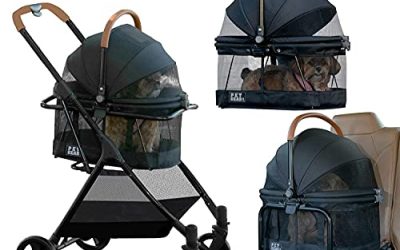
The single most important feature on a jogging pet stroller is how the front wheel behaves when you speed up. A wheel that swivels freely is handy for turning in a shop aisle, but at jogging pace it can start to wobble from side to side, and that wobble gets worse the faster you go. Look for a front wheel that locks into a fixed straight-ahead position, or a switch between swivel mode for walking and locked mode for running. A three-wheel layout with one front wheel and two rear wheels is the usual jogging arrangement. Check the listing for a stated lock or fixed mode instead of assuming every three-wheel stroller is built for running.
Wheel size, tires and suspension
Big wheels roll over cracks, tree roots and gravel far more smoothly than small ones, and that matters twice over at running pace: your pet feels every bump, and you feel every jolt through the handle. Rear wheels of around twelve inches or larger are a good sign, and air-filled or foam-filled tires absorb shock better than hard plastic wheels. Some frames add rear suspension, which helps on uneven park paths and packed dirt. Also check whether the tires are described as jogging tires or all-terrain tires in the listing. Small hard wheels may look sporty, but they will rattle your pet and fight you on anything rougher than smooth pavement.
Weight capacity and cabin fit for an adult pet
An adult pet is at full weight, so the stated weight limit is a hard ceiling rather than a rough guide. Measure your pet and compare its weight with the maximum weight recommendation on the listing, leaving a margin for a blanket, water and gear. Then check the cabin itself: your pet should be able to sit upright, turn around and lie down without pressing against the mesh. A tight cabin makes an adult animal restless, and a restless animal shifts its weight and unbalances the stroller. Check the interior length, width and height, and choose a limit that comfortably exceeds your pet rather than matching it exactly.
Ventilation, safety tethers and visibility
A running pet stroller is a moving box, so airflow is a safety issue, not a comfort extra. Look for mesh windows on the top, front and sides, and check that the mesh is described as ventilated or breathable rather than a single small panel. The cabin should include at least one internal safety tether that clips to your pet’s harness, because a startled adult dog can push through an unsecured opening. A canopy helps in drizzle, and reflective trim makes dawn and dusk runs safer. Look for a peek-a-boo window or top opening so you can check on your pet without stopping, since you cannot read its body language while running.
Which One Fits Your Situation
Daily runs on pavement with a medium adult dog
Choose a true three-wheel jogger with a lockable front wheel, twelve-inch or larger rear wheels, and a weight limit well above your dog’s weight. Pavement is forgiving, so straight tracking and a settled cabin matter more than suspension. A one-hand fold helps when you get home, and a storage basket holds a leash, water and waste bags. Skip light walking strollers with small swivelling wheels, which shimmy the moment you pick up the pace.
Trail outings with an older or recovering adult pet
Choose a jogging frame with the largest wheels you can find, air-filled or foam-filled tires, and suspension if offered. An older pet that rides because it can no longer run beside you needs a smooth cabin more than speed, so prioritise shock absorption, a low entry and a padded liner. Ventilation matters too, since older animals overheat easily. A fixed front wheel still helps on rough ground, keeping the stroller from darting sideways over roots and ruts.
Mixed walking and jogging with a small adult cat or dog
Choose a convertible frame whose front wheel switches between swivel and locked modes, so you can steer through streets and lock it straight for jogging stretches. A small adult cat or dog needs no huge cabin, but it does need a secure tether and full mesh coverage, because cats will test every opening. Look for a top entry as well as a front entry, since lowering a cat in from above is calmer than coaxing it through a front flap.
Long outings with gear, water and a larger adult pet
Choose a jogging stroller with a high weight capacity, a wide cabin and generous storage, accepting a heavier frame in exchange. On a long outing you will carry water, treats, a rain cover and possibly a first aid kit, so a large under-seat basket and a parent tray with cup holders earn their keep. Check the folded size against your car boot, because the biggest jogging frames fold down large. An adjustable handle matters more on a long run.
Common Mistakes
- Buying a walking stroller and calling it a jogger. Many three-wheel pet strollers look sporty but are built for walking pace, with small hard wheels and a front wheel that never locks. At running speed the front wheel shimmies, the frame pulls to one side, and your pet gets bounced around. Before you buy, confirm in the listing that the front wheel locks or has a fixed mode, that the rear wheels are large, and that the product is described as a jogger rather than a general-purpose stroller. If the listing never mentions jogging, running or a lockable wheel, treat it as a walking stroller no matter how athletic it looks, and keep looking for a frame that is genuinely built for pace.
- Ignoring the weight limit until your pet is already in the cabin. An adult pet at full weight can sit close to a small stroller’s limit, and adding a blanket, a water bottle and a bag of treats pushes it over. An overloaded stroller steers badly, wears its wheels faster and can make the frame flex at speed, which is exactly when you need it rigid. Weigh your pet on a bathroom scale, add a realistic margin for gear, and choose a stroller whose maximum weight recommendation clears that total with room to spare. A cabin that fits your pet’s body matters just as much, so check the interior measurements and make sure your animal can sit, turn and lie down without pressing against the mesh on any side.
- Skipping the test run with your pet before a real outing. A stroller that looks perfect in the hallway can feel very different to your pet at jogging pace, and the first time you discover that should not be three miles from home. Start with short walks around the block, then a slow jog on a quiet street, watching for signs that your pet is stressed: panting, pawing at the mesh, trying to climb out or going rigid. Keep the first outings short and end on a calm note, and bring treats so the cabin becomes a pleasant place. If your pet never settles after several gentle introductions, the cabin may be too small, too hot or too bouncy, and no amount of pushing through will fix that.
- Forgetting ventilation and heat on warm days. A mesh cabin in direct sun warms up fast, and a running pet stroller adds your body heat and the heat rising from the pavement. Adult pets, especially flat-faced breeds and older animals, can overheat quickly inside a closed cabin with poor airflow. Choose a stroller with mesh on several sides, use the canopy for shade, plan runs for the cooler parts of the day, and stop to offer water. Never assume that a single small mesh panel is enough ventilation for a long run in warm weather, and learn the early signs of overheating in your pet so you can stop before it becomes an emergency.
- Choosing on folded size alone and regretting the ride. A stroller that folds tiny is tempting if your car boot or hallway is small, but the most compact frames usually have the smallest wheels and the least suspension. That trade-off shows up on the first rough path, when your pet feels every crack and you feel every jolt through the handle. Measure your storage space first, then buy the largest-wheeled jogging frame that still fits when folded. Check the folded dimensions in the listing rather than guessing, and remember that pop-out or quick-release wheels can make a bigger frame fit a smaller space without giving up ride quality.
Frequently Asked Questions
Can I jog with any three-wheel pet stroller?
No. A three-wheel layout alone does not make a stroller safe for jogging. You need a front wheel that locks straight, large air-filled or foam-filled tires, and a frame built to stay stable at running pace. Walking strollers with small swivelling wheels shimmy badly once you speed up, which tires you and stresses your pet. Check for a lockable front wheel and a jogging description before you buy.
What weight limit do I need for an adult dog?
Choose a stroller whose maximum weight recommendation clears your dog’s weight with a margin for gear. Weigh your dog first, then add a blanket, water and anything else you will carry inside. A limit that only just matches your dog makes the frame flex and steer poorly at speed. If your dog is close to a model’s limit, move up to a higher-capacity stroller instead of hoping it copes.
How do I get my adult cat used to a jogging stroller?
Introduce the stroller indoors, with the cabin open and treats inside so your cat explores it on its own terms. Progress to short walks, then brief slow jogs, ending before your cat gets stressed. Clip the tether to a harness, never a collar, and keep the mesh closed once moving. Some cats never enjoy riding; if yours stays distressed after introductions, accept that and find another way to share outings.
Is a jogging pet stroller safe for an older adult pet?
Yes, provided the stroller suits the animal’s needs. Older pets often enjoy outings they can no longer manage on foot, but they need a smooth ride, good ventilation and an easy entry: large air-filled tires, suspension and a low step-in height. Keep outings short and run in cooler parts of the day, and watch for panting. Check with your vet first if your pet has joint, heart or breathing problems.